Not a code generator.
An automated engineering team.
Built on LangGraph.
Deterministic. Auditable.
A LangGraph state machine coordinates every agent through 8 fixed stages with built-in checkpoints. No black box — full agent log, cost breakdown and audit trail for every run.
Detect pipeline type, load domain config, bootstrap state
Deep reasoning: architecture debate, security review, meta-critique
Specialists per vertical — fintech, crypto, AI, infrastructure
High-frequency tasks: DevOps config, cost tracking, formatting
Fintech. Crypto. AI.
Not a general-purpose tool — each vertical has dedicated domain agents carrying production-grade knowledge. FIX protocol. Reentrancy guards. Hybrid retrieval.
Pipeline pauses.
You review. Then it ships.
Choose your level of control. Gates pause the pipeline at critical decision points — a kanban card appears with a GitHub link so you can review the code before approving.
Watch every agent think.
Every decision logged.
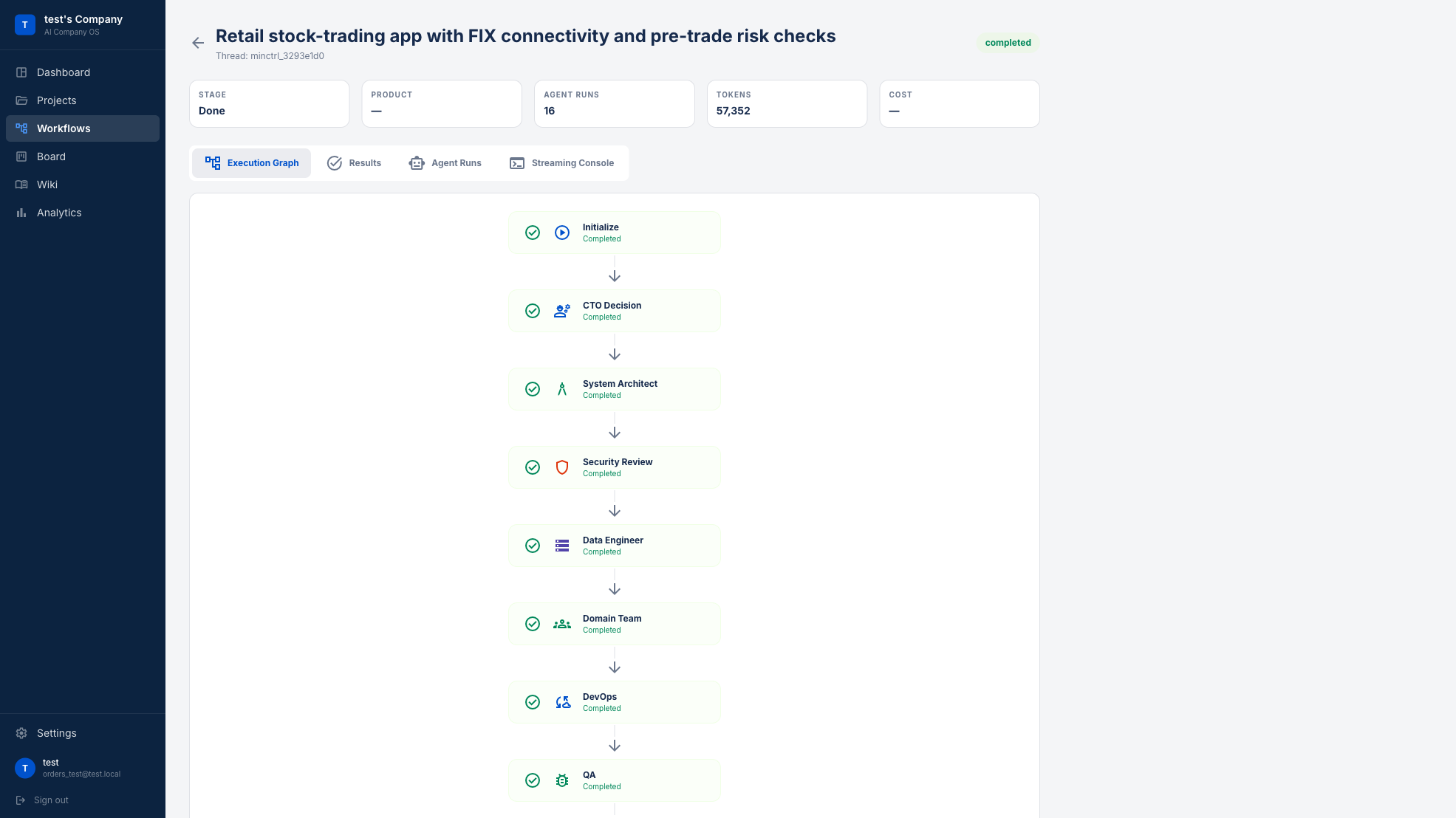
The execution graph shows every agent, every stage, every output in real time. Streaming console gives a live feed of agent reasoning. Full cost breakdown per agent, per run.
Everything in one workspace
Six integrated modules, built around the agent pipeline. Each one kept in sync with the live run state.